[{"pid":"7285", "type":"3", "objective":"1", "answer":{"zubA0q":"were used to cooking", "0HNwhz":"are used to cooking", "YkBWJN":"were used to riding", "fKKjOa":"are used to taking the bus", "qg4Yp6":"were used to sending telegrams", "PMWhXm":"are used to chatting online", "Wd4bxr":"are used to sending text messages", "VHukbT":"were used to writing letters"}}, {"pid":"8172", "type":"3", "objective":"0", "answer":{"R611q0":"Answers will vary.", "oxnOLU":"Answers will vary.", "jEq8dr":"Answers will vary.", "w51V9V":"Answers will vary."}, "corrate":{"R611q0":"", "oxnOLU":"", "jEq8dr":"", "w51V9V":""}}]

HOME  > Key Stage 3 > Time Zones 3 > Unit 9. I used to live in a village. > Chapter 1

HOME  > Key Stage 3 > Time Zones 3 > Unit 9. I used to live in a village. > Chapter 1

Language Focus: Practice B

Julie is comparing how people used to live in the past with how they live now. Look at the pictures and complete the sentences with the structure be used to + gerund. Then think of and type two more comparisons.
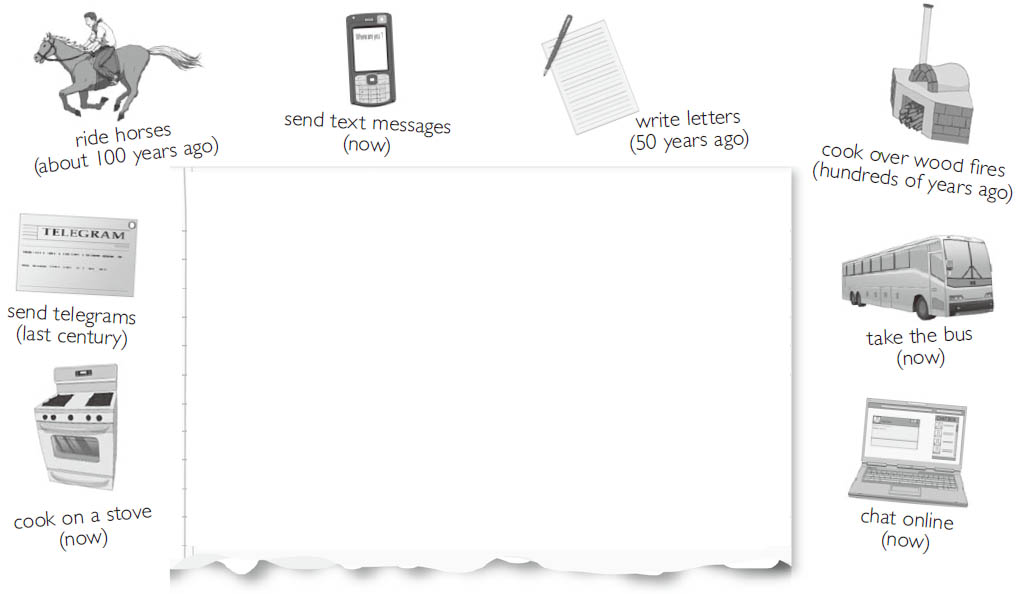

Hundreds of years ago, people (1)  their food over wood fires, but now they (2)   food on a stove .  About 100 years ago, there wasn't any public transportation and people (3)  horses from one place to another. But nowadays we (4)


In the last century, people (5)  to communicate, yet today we (6)  with our friends. And we (7)  to each other too, but people (8)  to friends and family 50 years ago.


(9) , but nowadays .

(10) , but now .